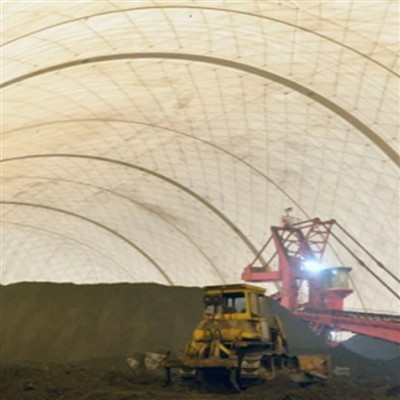
A PTFE Coated Fiberglass Membrane is an architectural system primarily utilizing fiberglass fabric coated with Polytetrafluoroethylene (PTFE). Renowned for its exceptional durability, self-cleaning properties, and long service life, it represents a premium, permanent class of tensile membrane structure, often selected for high-profile and architecturally significant projects.


Core Material Properties
PTFE Coated Fiberglass Membrane is a composite material consisting of a fiberglass substrate-which provides high tensile strength-coated with a PTFE resin surface layer. This coating is responsible for its outstanding weather resistance, chemical inertness, and self-cleaning capability. The material typically has a thickness ranging from 0.55 to 1.0 millimeters.
Key Performance Characteristics
Durability & Weather Resistance: PTFE membrane exhibits remarkable stability across an extreme temperature range, from -70°C to +260°C. It is highly resistant to UV degradation and long-term aging, contributing to a design life typically between 25 and 30+ years with minimal degradation.
Self-Cleaning Function: The non-stick, low-friction surface of PTFE prevents the adhesion of dust, pollutants, and organic growth. Most surface contaminants are effectively removed by natural rainwater runoff, significantly reducing long-term maintenance costs and efforts.
Mechanical Performance: The material possesses high tensile strength (typically ≥50 kN/m in both warp and weft directions), excellent tear resistance, and low creep. These properties make it ideally suited for large-span, permanently tensioned applications.
Safety & Environmental Profile: PTFE membrane is inherently fire-resistant, typically achieving a B1 fire rating. It does not drip or emit significant toxic fumes when exposed to fire. Its chemical stability ensures high resistance to corrosion from acids, alkalis, and other industrial pollutants.
Considerations & Limitations
The primary limitation is its higher initial cost, often 2-3 times that of standard PVC membranes. Additionally, it is less flexible than PVC and requires a higher degree of precision and expertise during both the fabrication and installation phases.
Common Structural Applications
PTFE Coated Fiberglass Membrane: In this form, the PTFE membrane is stretched into shape by a system of steel cables and edge details, supported by masts, arches, or perimeter compression rings. This method creates dramatic, sweeping forms and is widely used for large-span roofs such as airport terminals and major stadiums.
Frame-Supported PTFE Structures: Here, a rigid structural framework of steel trusses or space frames provides the primary support. The PTFE panels are tensioned and fixed over this skeleton. This approach offers great stability and is commonly applied in smaller venues, entrance canopies, and landmark pavilions.
Cable Dome PTFE Structures: This advanced system employs a continuous network of tensioned steel cables as the primary load-bearing structure, with the PTFE membrane serving as the weatherproof enclosure. It is a highly efficient, lightweight solution for covering very large areas like sports arenas and convention centers.
ETFE-PTFE Composite Systems: This hybrid approach combines the superior mechanical strength and longevity of PTFE as the primary structural layer with an inner layer of ETFE foil (often used as pneumatic cushions). The result is a system that offers enhanced thermal and acoustic insulation alongside dynamic light transmission properties, suitable for the most ambitious and iconic architectural projects.
Hot Tags: ptfe coated fiberglass membrane, China ptfe coated fiberglass membrane manufacturers, factory, septum membrane, Coal Yard Enclosure, Wastewater Tank Cover, PTFE Coated Fiberglass Membrane, membrane structures for industrial buildings